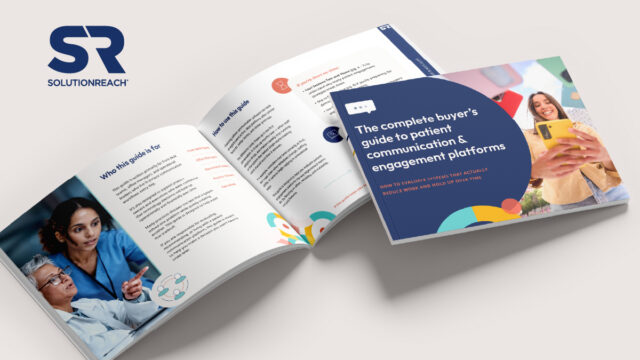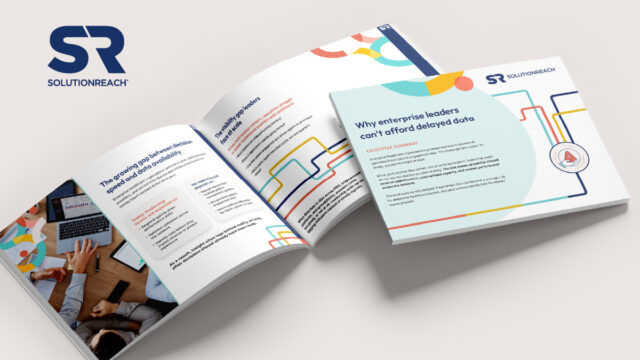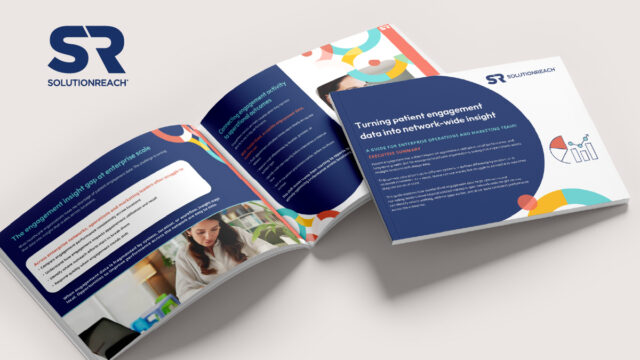
Growth is exciting. It is also operationally unforgiving.
For multi-location healthcare providers—such as dental service organizations (DSOs), eye care groups, and hospital systems—scaling the patient experience is just as important as scaling operations. As organizations grow, however, delivering a consistent, personal experience across locations becomes harder.
The challenge is not effort, but infrastructure.
When systems are not designed for enterprise scale, teams rely on workarounds. Messaging becomes inconsistent. Reporting becomes fragmented. Visibility declines. Over time, this creates more than operational strain: it introduces revenue leakage, inconsistent brand perception, and avoidable patient churn.
To preserve personalization at scale, enterprise organizations must move from reactive fixes to intentional, organization-wide systems. That means clear visibility, consistent controls, and confidence that patient communications are executed reliably across every location—without limiting the flexibility local teams need to serve their communities. Integrated enterprise patient communication software is essential to establishing this balance, simplifying workflows while remaining fully integrated and easily scalable.
Balancing Autonomy and Scalability
Managing staff schedules, patient messaging, rescheduling, and new-patient acquisition is already challenging. Those challenges compound as organizations add locations, especially when systems and processes fail to scale alongside growth.
Successful scaling is not equivalent to adding technology. It requires organizations to consolidate processes in ways that promote consistency without creating rigidity.
One of the most common friction points for enterprise organizations is balancing organization-wide oversight with location-level autonomy. Leadership teams need visibility, governance, and consistency, while individual practices must retain the flexibility to meet the needs of their local patient populations. Long-term success depends on achieving both without increasing operational strain.
Enterprise growth requires standardization, but patient loyalty requires personalization. Systems that allow for both are ultimately what drive effective and sustainable growth.
What “Enterprise-Ready” Patient Communication Software Really Means
Adding more communication tools does not solve the scaling problem. Consolidating workflows does.
When evaluating patient communication solutions, enterprise organizations should look beyond surface-level features and consider whether a platform truly supports scale.
Enterprise-ready capabilities typically include:
- Centralized administrative controls to manage users, permissions, and locations efficiently;
- Enterprise-approved templates and auto-branding to ensure consistent, professional patient messaging;
- Unified analytics and reporting that surface performance trends by location, region, or provider;
- Seamless integrations with EHRs, payment systems, and existing technology stacks to reduce manual work.
Together, these capabilities help organizations scale with clarity and confidence rather than relying on fragmented systems and manual oversight.
Patient Communication as a Driver of Growth
As organizations grow, patient communication often becomes harder. This isn’t because teams aren’t working as hard: it’s because their systems weren’t designed to operate at enterprise scale. Missed appointments and no-shows remain two of the most common sources of lost revenue across healthcare organizations. In many cases, the issue isn’t patient intent, but delayed, inconsistent, or unclear communication.
By integrating patient engagement tools with scheduling and payment systems, organizations can create a more unified experience that minimizes no-shows and increases overall satisfaction and loyalty.
Enterprise-level patient communication platforms support:
- Two-way patient communication that accelerates response times;
- Automated recall and reactivation workflows;
- Automated appointment reminders to minimize no-shows;
- Post-appointment follow-up to keep patients engaged.
Integrated solutions allow practices to send batch messaging for appointment reminders or even payment requests, allowing practices to instantly communicate with large numbers of patients at once. These platforms also support secure payment links via text, streamlining the payment process and shortening the time between services rendered and payment received, which helps reduce revenue leakage.
These workflows can be replicated across locations, helping organizations increase appointment volume and reduce no-shows without increasing staffing demands.
Reputation Management at Scale
As organizations expand, reputation management becomes both more complex and more consequential.
In today’s competitive landscape, patient reviews are often one of the most powerful differentiators between practices, as they play a central role in many patients’ decision-making processes. Responsiveness to reviews is a powerful way for practices to enhance their brand perception, but this degree of responsiveness and personalization becomes exponentially harder to maintain as an organization scales.
Enterprise-ready patient engagement platforms integrate reputation management into daily workflows by enabling organizations to:
- Embed review requests and surveys into patient messaging;
- Increase review volume while maintaining consistent response standards;
- Collect, analyze, and respond to feedback in a centralized system.
By making reputation management part of existing patient communication, organizations can transform a labor-intensive process into a more sustainable one. Templates and centralized tools support timely, professional responses while still allowing locations to communicate authentically with their communities.
Many platforms also offer custom newsletters and marketing templates. This helps new locations align with brand standards while tailoring messaging locally, strengthening trust without sacrificing personalization.
The result is a stronger, more consistent brand reputation and a solid foundation for sustainable enterprise growth.
Making Patient Communication a Foundation for Scale
Effective patient communication is not an add-on. It is a core operational capability for growing healthcare organizations.
When treated as infrastructure, enterprise-level patient engagement:
- Protects revenue;
- Strengthens patient loyalty;
- Standardizes brand experience;
- Reduces operational friction;
- Supports scalable growth.
Healthcare groups that invest in integrated, enterprise-ready communication systems position themselves to scale without sacrificing personalization — and without increasing strain on already stretched teams.
Organizations that treat communication as part of care itself are better positioned to build loyalty and sustain growth. Clear, responsive communication supports treatment acceptance, improves financial transparency, and reduces friction for both patients and staff.
Enterprise-ready patient communication platforms make it possible to scale without sacrificing the personal touch or adding strain to already-stretched teams.
Solutionreach’s enterprise patient engagement platform is designed specifically to help multi-location healthcare organizations scale communication, streamline operations, and preserve the personal touch that drives patient loyalty.
👉 Connect with Solutionreach to explore how enterprise-ready patient communications can support scalable growth and consistent patient experiences across your organization.
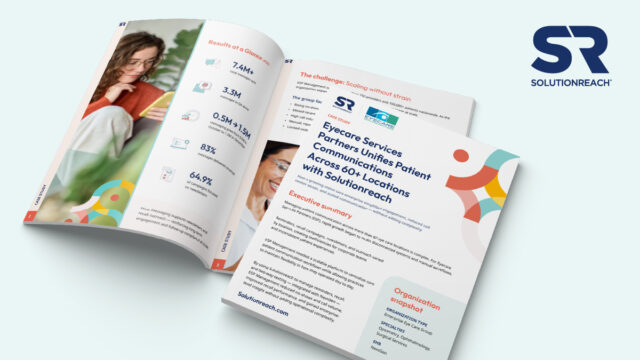
How do 60+ locations standardize patient communication without overwhelming staff?
👉 Download the ESP case study to see how unified workflows reduced no-shows, lowered call volume, and scaled engagement across 200+ providers.