If you’ve invested in healthcare automation software and aren’t seeing the efficiency gains you expected, you’re not alone.
In 2025, 62% of hospital CIOs said their focus is getting more out of existing IT investments, not adding new ones. At the same time, 57% of physicians say the biggest opportunity for technology is reducing administrative burden.
And yet, 76% of healthcare organizations say managing too many disconnected tools actually makes operations harder.
Most enterprise teams aren’t looking for more tools. They’re trying to get more value from what they already have.
And yet, as automation increases, operations don’t always feel simpler.
Tasks move faster. Coordination doesn’t.
That’s where the friction shows up.
The issue usually isn’t the tools. It’s what happens between them.
When systems don’t connect, your team fills the gaps. Every tool adds another handoff, another dependency, another point of failure.
Automation improves steps. Workflows determine how the operation actually runs.
What Is Healthcare Automation Software?
Q: What is healthcare automation software designed to do?
It reduces repetitive administrative work so your team can focus on higher-value tasks.
Most commonly:
- Scheduling and reminders
- Intake and eligibility
- Patient communication and follow-up
- Billing and authorizations
The need is obvious. Administrative work keeps growing.
Automation helps at the task level.
But healthcare operations don’t live in one system. They move across teams, tools, and handoffs.
That’s where value is gained or lost.
How Solutionreach Helps
Solutionreach works alongside your existing systems to align scheduling, reminders, and follow-up communication, reducing the need for manual coordination.
👉 Explore Patient Engagement Platform →
Why Do Many Healthcare Automation Solutions Fall Short?
Q: Why does automation sometimes create more work?
On paper, it should simplify operations.
In practice, many teams still feel just as stretched.
The difference comes down to how well systems work together.
The point solution problem
Most tools solve one problem.
Individually, they work. Together, they create friction.
- Handoffs still require manual effort
- Staff connect processes that should already be connected
- Data doesn’t move cleanly between systems
Over time, the work shifts from doing tasks to managing gaps.
The integration gap
This is where breakdowns happen.
The 2025 CAQH Index shows this is where automation breaks down fastest — manual transactions cost providers $8.03 each compared to $2.65 electronically.
When workflows depend on manual steps between systems, costs rise and consistency drops.
Disconnected systems don’t just slow teams down. They make operations harder to trust.
How Solutionreach Helps
Solutionreach integrates with your systems to align communication workflows across scheduling, messaging, and follow-up.
👉 Explore Integrations →
How Do Disconnected Patient Workflows Break Automation?
Q: Why do workflows matter more than features?
Automation breaks at the handoffs.
Each step in the patient journey touches a different system. When those systems aren’t aligned, your team becomes the connector.
That shows up as:
- Reminders sent for canceled appointments
- Recall outreach that ignores actual care history
- Messages that don’t reflect real-time operations
These aren’t edge cases. They’re common when systems aren’t aligned.
The result:
- More time spent fixing issues
- Inconsistent patient communication
- Less confidence in operational data
When workflows connect, those gaps start to disappear.
How Solutionreach Helps
Solutionreach connects messaging, reminders, recall, and engagement directly to scheduling and patient data so workflows stay aligned.
👉 Explore Workflow Automation →
What Changes When Healthcare Automation Works Across Connected Workflows?
Q: What actually improves?
The difference is practical and immediate.
- Less manual coordination: Teams stop bridging gaps between systems
- Fewer unnecessary calls: Fewer issues to clarify or fix
- More consistent communication: Messages reflect what’s actually happening
- Clearer operational visibility: Leadership sees reliable, aligned data
This doesn’t come from more automation.
It comes from better coordination.
How Solutionreach Helps
Solutionreach helps align communication workflows across scheduling, messaging, and follow-up so teams spend less time coordinating and more time supporting patients.
👉 Explore Patient Engagement Platform →
What Should Leaders Look for in Patient Engagement Automation Platforms?
Q: How should enterprise teams evaluate solutions?
At this stage, most organizations aren’t looking for more automation.
They’re looking for less coordination.
Focus on:
- Integration with existing systems
- Workflow support across the full patient lifecycle
- Scalability across locations
- Centralized oversight with local flexibility
- Reduced manual coordination
The goal isn’t another tool.
It’s a system that’s easier to run.
How Solutionreach Helps
Solutionreach supports connected workflows across multi-location organizations, helping teams scale without adding complexity.
👉 Explore Enterprise Patient Communication →
Frequently Asked Questions
What is healthcare automation software?
Technology that reduces manual administrative work like scheduling, reminders, and follow-up.
How is workflow automation different?
Automation handles tasks. Workflow automation connects those tasks across systems.
Why do automation tools fail?
Because systems don’t share data, and staff end up managing the gaps.
Which workflows benefit most?
Scheduling, reminders, intake, recall, and follow-up, especially when connected end to end.
How do you ensure automation improves efficiency?
Prioritize integration and workflow alignment, not just features.
Summary
Healthcare automation software can improve efficiency.
But only when workflows are connected.
When tools operate in isolation, the work doesn’t disappear. It shifts to your team.
The challenge usually isn’t automation itself.
It’s the coordination around it.
Organizations that align workflows reduce operational strain, improve communication, and create more consistent patient experiences.
See What Connected Workflows Look Like in Practice
If your systems are still creating work instead of removing it, the issue may not be automation. It may be how your workflows connect.
Solutionreach helps healthcare organizations align scheduling, reminders, messaging, and follow-up so teams spend less time coordinating and more time supporting patients.
👉 Request a Demo →
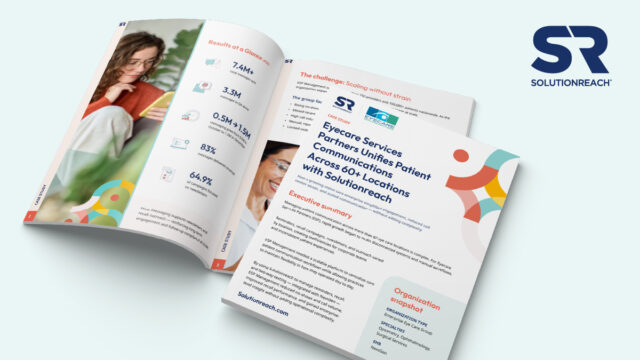
How do 60+ locations standardize patient communication without overwhelming staff?
👉 Download the ESP case study to see how unified workflows reduced no-shows, lowered call volume, and scaled engagement across 200+ providers.