Eye care patients hang up on voicemail because they want an exam booked, not a message left. Optometry front desks are also busy with check-in, optical and dispensing, so calls roll to voicemail at peak times. An AI receptionist answers those calls and books the exam while the patient is still on the line.
Key takeaways
- Voicemail asks the patient to leave a message and then answer a callback from a number they may not recognize.
- Eye care calls go unanswered during check-in, at the optical counter, at lunch and after hours.
- A five-location group, Fadel Eye Professionals, reported 1,300 calls answered and 71 appointments booked in 42 days with an AI receptionist.
- Staff can keep answering first, with the AI picking up only when a call goes unanswered.
- Urgent eye problems should always go to your team under rules you set.
Why do eye care calls go to voicemail?
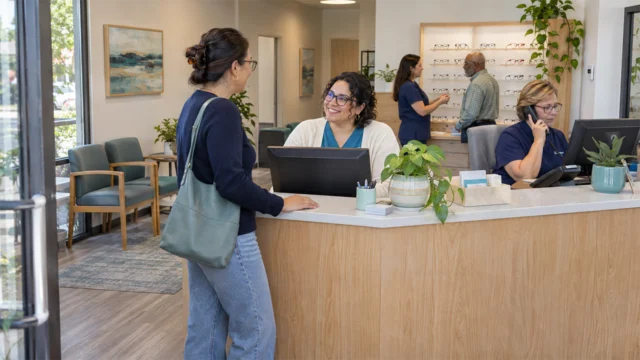
An optometry office runs several things at once: check-in, pretesting, exam lanes, the dispensing table and the phones. When the front desk is with a patient and the optical team is fitting glasses, the line rings out. It happens at lunch, on busy mornings and after the office closes.
The Fadel Eye Professionals case study describes the gap as structural, a timing mismatch between when patients call and when staff are free, not a staffing problem.
Why don’t patients leave a message or call back?
Patients call to schedule an exam, not to start a conversation with an inbox. If nobody answers, many move on to the next practice. If they do leave a message, your team calls back later from the office main line.
A Pew Research Center survey found that about 80 percent of U.S. adults generally don’t answer cellphone calls from unknown numbers, and 14 percent generally ignore a voicemail when they don’t answer. A callback from a number the patient doesn’t recognize often goes unanswered. Fadel Eye Professionals saw the same pattern: patients who reached voicemail rarely called back.
What did one five-location eye care group see?
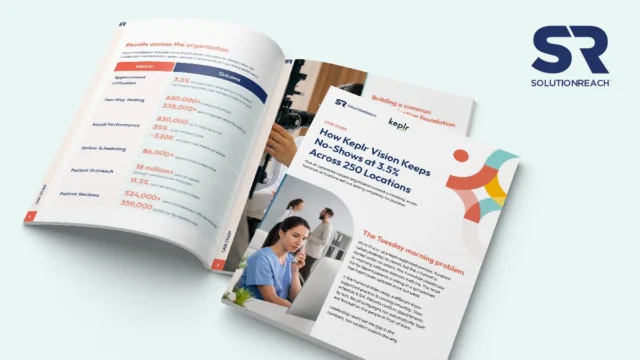
Fadel Eye Professionals, a five-location eye care group in Texas, started using Solutionreach’s AI Receptionist, Stella, on April 28, 2026. Its practice manager estimated roughly $974,000 a year in exposure from missed calls, based on one missed patient call per day per location at $750 per visit.
Staff get the first chance to answer every call. After four rings with no answer, Stella picks up, talks with the patient, books the appointment and logs the call. Stella was set up once for all five locations, with no new workflows for the front desk.
| Result over 42 days (April 28 to June 9, 2026) | Fadel Eye Professionals |
|---|---|
| Calls answered by Stella | 1,300 |
| Scheduling calls | 140 |
| Appointments booked | 71 |
| Scheduling conversion rate | 51 percent |
| Added production, at the group’s $750 planning value | $53,250 |
| Reported return on investment | 17x |
| Break-even point | The third booked appointment |
Beyond scheduling, Stella handled general questions, contact lens inquiries, prescription requests and cancellations. About 5 of the 1,300 callers raised any concern, which is under 1 percent.
Results varied by location. Scheduling conversion ranged from 44 to 60 percent at four locations, and was 7 percent at the newest, lowest-volume location during its ramp-up. Production is based on the group’s own $750 planning value, not billed revenue. Results are not guaranteed. Read the full Fadel Eye Professionals case study.
Practice manager Victor Rodriguez said he purposely didn’t tell his staff the system was on, “because I didn’t want them to rely on it.” Staff kept the first chance to answer, and Stella covered the calls they couldn’t reach.
How does voicemail compare with an AI receptionist in eye care?
| Voicemail | AI receptionist connected to your schedule | |
|---|---|---|
| Patient experience | Leaves a message and waits | Gets an answer right away |
| Booking | A callback is needed | Books during the call, for the appointment types you allow |
| Contact lens and prescription questions | Wait for a callback | Common questions answered, the rest sent to your team |
| Urgent eye problems | Wait for a callback | Routed to your team under rules you set |
| Visibility | A list of messages | Every call and text logged, with transcripts and outcomes |
What should an eye care AI receptionist do and not do?
Solutionreach’s AI Receptionist answers patient calls and text messages when your team can’t, and can book, reschedule and cancel appointments with supported practice management systems. It answers questions about hours, address and practice information, and confirms appointment details.
It does not replace your front desk, handle conversations meant for staff, or override your scheduling rules. You choose the appointment types and providers it can schedule, when it is active, and which requests go to your team. Callers are told they are speaking with an AI. It is built to align with healthcare privacy and compliance requirements, including HIPAA.
For sudden vision changes or eye pain, write your urgent-call rules before you go live so those callers reach your team.
How do you set it up the way Fadel Eye Professionals did?
- Keep your team answering first.
- Let the AI receptionist pick up only when a call goes unanswered, or limit it to after-hours and busy times.
- Set the appointment types and providers it can schedule.
- Write your urgent-call and escalation rules.
- Track calls answered, appointments booked and scheduling conversion for 30 days, then adjust.
Related: Best AI receptionists for optometry and eye care practices and Does an AI receptionist work with Crystal PM?
See how Stella covers the calls your team can’t take.
FAQ
They want an exam booked, not a message left. Many move on to another practice, and a callback from an unfamiliar number often goes unanswered.
It answers the call right away, books the appointment in your schedule for the appointment types you allow, and logs the conversation for your team.
No. It covers the calls your team can’t take, and your team handles everything that needs judgment.
Requests outside the AI receptionist’s design are routed to your office. Set your urgent-call rules before you go live.
It can answer common questions and send the rest to your team. At Fadel Eye Professionals, Stella handled contact lens inquiries and prescription requests along with scheduling.
Results vary by location and are not guaranteed. Fadel Eye Professionals reported 1,300 calls answered, 71 appointments booked and a 17x return on investment over 42 days.