CUSTOMER STORY · EYE CARE · TEXAS · JUNE 2026
Practice
| CUSTOMER | FOOTPRINT | SPECIALTY |
| Fadel Eye Professionals | 5 locations · Texas | Optical & vision care |
Results
| 71 Appointments booked From 1,300 calls answered · 42 days · 5 locations · Fadel Eye Professionals |
$53,250 Production added
At $750 avg appointment value · avg $10,650 per location · Fadel Eye Professionals |
| 51% Scheduling conversion rate
71 of 140 scheduling calls converted to booked appointments · Fadel Eye Professionals |
17x Return on investment
Group reached breakeven with the 3rd booked appointment · Fadel Eye Professionals |
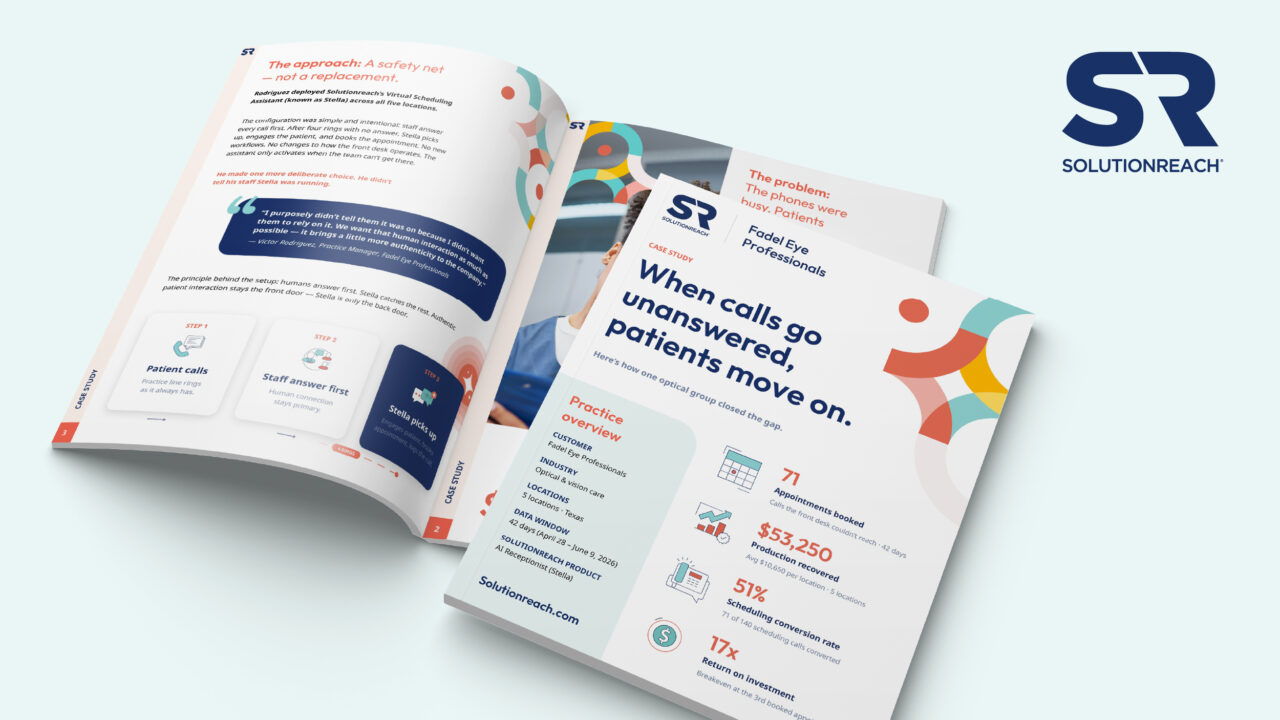
Download Case Study: When calls go unanswered patients move on
What problem was Fadel Eye Professionals trying to solve?
Fadel Eye Professionals was losing patient calls to voicemail during peak hours and after closing. At five locations across Texas, even a small number of missed calls per day compounded into a significant revenue exposure — practice manager Victor Rodriguez estimated the annual risk at nearly $974,000.
Running five optical practices means five front desks, five phone lines, and five windows of time when calls can go unanswered. For Fadel Eye Professionals, the problem surfaced most at their Katy location — but it wasn’t isolated. Across the group, patients who reached voicemail rarely called back.
Rodriguez calculated the exposure himself: at $750 per visit, missing even one patient call per day per location adds up to nearly $974,000 in potential annual revenue. That figure is his own estimate — the number he was solving for when he started looking at solutions.
The team wasn’t the problem. The gap was structural — a timing problem between when patients called and when staff could answer.
How did Fadel Eye Professionals deploy the AI Receptionist?
Fadel Eye Professionals deployed Solutionreach’s AI Receptionist, Stella, as a missed-call backstop across all five locations. The configuration: staff answer every call first. After four rings with no answer, Stella picks up — engaging the patient, booking the appointment, and logging the call. Practice manager Victor Rodriguez deliberately chose not to tell staff the AI receptionist was running, so they kept answering the way they always had.
The deployment was intentionally low-friction. No new workflows for staff. No changes to how calls were answered. Stella only activated when a call wasn’t getting through — during a busy stretch, over lunch, or after closing.
“I purposely didn’t tell them it was on because I didn’t want them to rely on it. We want that human interaction as much as possible — it brings a little more authenticity to the company.”
— Victor Rodriguez, Practice Manager, Fadel Eye Professionals
The principle behind the setup: humans answer first. Stella catches what they miss. She’s a safety net, not a replacement — a distinction Rodriguez was deliberate about from the start.
What results did Fadel Eye Professionals see in 42 days?
In 42 days, Fadel Eye Professionals’ AI Receptionist answered 1,300 calls across five locations and booked 71 appointments — adding $53,250 in production the group would otherwise have missed. The scheduling conversion rate was 51%: 71 of 140 scheduling calls converted to booked appointments. The group achieved a 17x return on investment, reaching breakeven with the third booked appointment.
| Location | Calls | Appts | Conv. | Hrs saved | Production |
| Katy Vision Source | 428 | 30 | 57% | 2.6 hrs | $22,500 |
| Lauren Alexander at Potranco | 369 | 27 | 60% | 2.2 hrs | $20,250 |
| Anderson Lane Vision Source | 193 | 6 | 50% | 0.6 hrs | $4,500 |
| Lauren Alexander Optical | 145 | 7 | 44% | 0.8 hrs | $5,250 |
| Lauren Alexander at Shavano Park* | 165 | 1 | 7%* | 0.7 hrs | $750 |
| Group total | 1,300 | 71 | 51% | 7.0 hrs | $53,250
|
*Shavano Park was the newest and lowest-volume location. A 7% conversion rate at this stage is consistent with a ramp-up period for a recently opened or lower-traffic practice.
Production figures based on Fadel Eye Professionals’ $750 average appointment value — a figure the practice uses internally for planning purposes.
The 1,300 calls Stella handled weren’t all scheduling. She also fielded general questions, contact lens inquiries, prescription requests, and cancellations — the kind of front-desk volume that either eats into staff time or goes unanswered entirely. Staff got back 7.0 hours across the group during the 42-day window.
Forty-two days in, Rodriguez’s thinking has already evolved. He started with Stella as a quiet backstop. He’s now considering letting her take scheduling calls up front — routing those to Stella and sending everything else to staff. A safety net becoming a front-desk partner.
Why does this matter for other optical and vision practices?
Most multi-location optical practices lose patients to voicemail not because of poor care or understaffed teams, but because phones go unanswered during Tuesday afternoon rushes and after 5 p.m. on Thursdays. Fadel Eye Professionals’ 42-day results show this problem is both significant — the group estimated nearly $1M in annual exposure before acting — and solvable without disrupting the human-first culture practices work hard to maintain.
The deployment model Fadel used — staff first, Stella as backstop, no disruption to existing workflows — is designed for practices that want to close the gap without changing how their team operates. She runs in the background. Patients who reach her get helped. Patients who reach a person get the human interaction the practice values.
Forty-two days in, it looks less like a pilot and more like permanent infrastructure.
Frequently asked questions
How many calls can an AI receptionist handle for a multi-location practice?
Solutionreach’s AI Receptionist, Stella, handled 1,300 calls across five locations for Fadel Eye Professionals over 42 days — an average of 260 calls per location. Call volume varied by location: the busiest site (Katy Vision Source) received 428 calls; the lowest-volume site received 145.
Stella handled scheduling requests, general information questions, contact lens inquiries, prescription requests, cancellations, and after-hours overflow — not just appointment booking.
What is the scheduling conversion rate for an AI scheduler like Stella?
Fadel Eye Professionals saw a 51% scheduling conversion rate with Solutionreach’s AI Receptionist: 71 of 140 scheduling calls handled by the assistant converted to booked appointments over 42 days across five Texas optical locations.
Conversion varied by location, ranging from 44% at Lauren Alexander Optical to 60% at Lauren Alexander Vision Source at Potranco.
Will an AI receptionist replace my front desk staff?
Not in the model Fadel Eye Professionals used. Staff answer every call first. Stella only activates after four unanswered rings — she functions as a backstop, not a replacement. Practice manager Victor Rodriguez deliberately kept staff unaware she was running so they wouldn’t change their behavior.
Of 1,300 calls answered Stella, approximately five callers raised any concern — a rate below 1%.
How quickly does an AI receptionist pay for itself?
Fadel Eye Professionals achieved a 17x return on investment with Solutionreach’s AI Receptionist. The group reached breakeven with the third booked appointment — meaning the AI receptionist covered its monthly cost after three appointments, with all subsequent production representing net recovery.
How does an AI receptionist work after hours for an optical practice?
Solutionreach’s AI Receptionist answers calls in real time, including after-hours and during lunch or peak-volume periods when staff are unavailable. For Fadel Eye Professionals, a significant portion of the 1,300 calls handled came during windows the front desk couldn’t cover — previously, those calls would have gone to voicemail.
What is the ROI of AI scheduling software for an eye care practice?
Fadel Eye Professionals, a 5-location optical group in Texas, achieved a 17x return on investment using Solutionreach’s AI Receptionist over 42 days. The group added $53,250 in production from 71 appointments booked through the assistant — an average of $10,650 per location.
Production figures are based on Fadel’s $750 average appointment value — their internal planning figure.
How do you deploy an AI receptionist for a multi-location optical group?
Fadel Eye Professionals deployed Solutionreach’s AI Receptionist, Stella, across five locations simultaneously with a single group configuration. Calls roll to Stella after four unanswered rings at any location. Appointments are booked and logged per location. No change was required to how staff answer calls.
The group went live on April 28, 2026, and saw measurable results within the first 16 days.
Related resources
See how it works for your practiceGet a personalized look at how our AI Receptionist can support your team, capture missed calls, and book more appointments. Calculate the savings your practice could experienceEstimate how much missed calls may be costing your practice and the potential impact of recovering them. See how AI Receptionist worksExplore how our AI Receptionist, Stella, answers calls, schedules appointments, and supports patients when your team is unavailable. Download the full case studyRead the complete Fadel Eye Professionals story and see how our AI Receptionist helped turn missed calls into booked appointments. |
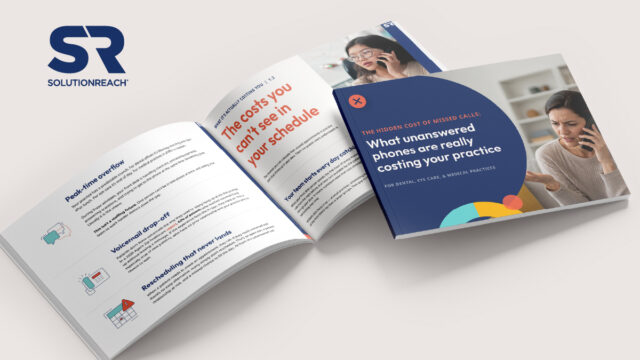
Your missed-call problem may be bigger than you think.
Use the guide to put a number on it.