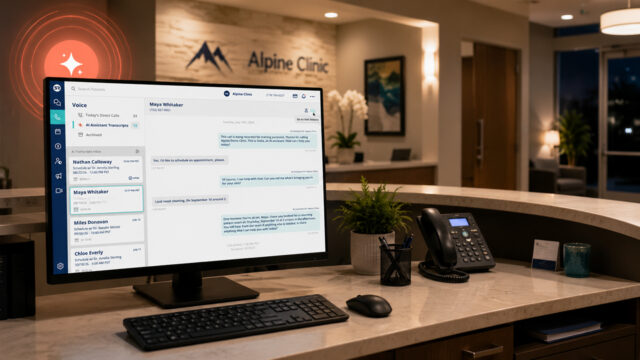
It’s Monday morning at a multi-location optical practice. The phones are already ringing before the doors open.
Front desk staff are working through voicemail messages from over the weekend. They jot down names and callback numbers on sticky notes, while juggling check-ins for the first patients arriving for appointments. A call comes in mid-check-in.
Their attention splits. One patient in front of them. One on the line — not allowing them to devote their full attention to either.
They answer what they can and let the rest go to voicemail, to be caught up on once things slow down.
By the time the morning’s first lull comes, the list of callbacks has only gotten longer, not shorter.
That was the part of Monday mornings Victor Rodriguez wanted to change.
What Monday mornings used to look like for multi-location eye care practices
Victor Rodriguez, practice manager for Fadel Eye Professionals, oversees five optical and vision practices across Texas. His team is good at what they do. But front desks can only stretch so far. When calls went to voicemail, patients rarely called back.
He had done the math. His team plans around a $750 average patient value. One missed patient a day across five locations put annual revenue exposure at nearly $974,000.
The problem came down to timing: patients were calling when his staff were already in the middle of something else.
Overnight voicemails rolled into the next morning. Returning those calls often took up the first hour of the day. While staff worked through that backlog, new calls were already coming in, and the same gap reappeared once the office hit its busiest hours.
Why the practice decided to try automated scheduling
All five practice locations were experiencing missed calls, but the Katy location made the coverage gap visible.
“Katy was the biggest issue — they were having an extreme amount of missed calls. So this is what kind of brought us to this situation.” — Victor Rodriguez, Practice Manager, Fadel Eye Professionals
The team was still the first point of patient contact, and Rodriguez wanted to keep it that way. Adding more people wasn’t the answer. The gap was coverage, not headcount.
Calls were coming in when staff were already tied up or after hours. He wanted fewer interruptions pulling his team away from the patients in front of them, not fewer people to handle them.
How the practice set up an automated scheduling assistant
In April 2026, Rodriguez deployed Solutionreach’s AI-powered Virtual Scheduling Assistant, known as Stella, across all five locations.
The setup was simple. Staff answered every call first. After four rings with no answer, Stella picked up, engaged the patient, booked the appointment, and logged the call.
Nothing changed for the front desk. There were no new workflows and no new systems to learn. He made one deliberate choice when the assistant went live.
“I purposely didn’t tell them it was on because I didn’t want them to rely on it. We want that human interaction as much as possible — it brings a little more authenticity to the company.” — Victor Rodriguez
Staff kept answering the phone exactly the way they always had. Stella only stepped in on the calls they couldn’t get to.
What changed first about the practice’s patient scheduling
Across five locations, Stella handled 1,300 calls. Seventy-one appointments were booked from calls that would have gone to voicemail, a 51% conversion rate on scheduling calls.
That added up to $53,250 in recovered production, or $10,650 per location on average. The group reached breakeven at the third booked appointment, a 17x return on investment over the 42-day window.
Katy Vision Source was the strongest single-location data point, handling 428 calls and booking 30 appointments, a 57% conversion rate.
Not every call was about scheduling. Stella also handled general questions, contact lens inquiries, prescription calls, and cancellations — the kind of everyday front-desk volume that either gets handled in the moment or waits until someone has time for it.
Across the group, front-desk teams got back 7.0 hours over the same window.
Nothing about the office got quieter. It just stopped opening each Monday already behind.
What the front desk team noticed about automated scheduling
The change showed up in the day-to-day work first.
With fewer calls rolling into voicemail, staff had more attention available for the patients already in the office. There was less moving back and forth between the phone and the counter, and fewer moments of stopping one task to handle another.
Peak call windows still happened, but fewer calls were stacking into a backlog waiting for staff to catch up.
Fewer voicemails were waiting at open, fewer live calls were interrupting check-ins, and Mondays started calmer.
What didn’t change about the practice’s patient interaction
The office still gets busy. Staff still manage the same patient relationships. Complex scheduling goes to humans, the way it always did. The front desk handles the conversations that need a person on the other end.
Rodriguez is still refining the setup as he learns more. Forty-two days in, he was already thinking about a different model: routing scheduling calls to Stella up front and letting staff handle everything else.
Scheduling coverage picked up what the staff couldn’t get to. The result was a practice that spent less time playing catch-up.
What the practice would tell another office considering an AI-powered scheduling assistant
For Rodriguez, the ROI was meaningful. But the more important thing was what was happening before patients ever reached the front desk.
“We were losing patients before they even got through.”
The setup didn’t ask the front desk to work differently. Staff still answered first. The workflow stayed the same. The difference was what happened when nobody could get to the phone.
Katy had been the clearest example of the missed-call problem. The bigger change was that fewer Mondays started behind.
How Monday mornings look now
The practice still runs the way it always has. Staff answer first. Patients still talk to people. The human side of the practice stays intact.
What’s different is what happens when they can’t get to the phone. Fewer patients hit voicemail and disappear, even the ones who call after the doors are closed. Staff have more attention left for the patients standing in front of them. The front desk just has fewer bottlenecks to work around.
If Mondays still start with a backlog, it might be worth seeing how Fadel Eye handled it. [hyperlink to VSA LP]

How do 60+ locations standardize patient communication without overwhelming staff?
👉 Download the ESP case study to see how unified workflows reduced no-shows, lowered call volume, and scaled engagement across 200+ providers.