

Managing patient communication across 19 locations, multiple dental specialties, and hundreds of team members is a coordination problem as much as it is a technology problem. When systems don’t work together, even well-run organizations end up with inconsistency: messages that don’t match, workflows that vary by location, and outreach that depends on who remembers to send it.
Dental Associates — one of Wisconsin’s largest independent dental groups, serving approximately 135,000 patients across 19 practices — was running patient communication on three separate platforms.
Consolidating onto Solutionreach changed how the team managed outreach, how quickly they could respond to schedule disruptions, and — measurably — how much treatment got scheduled.
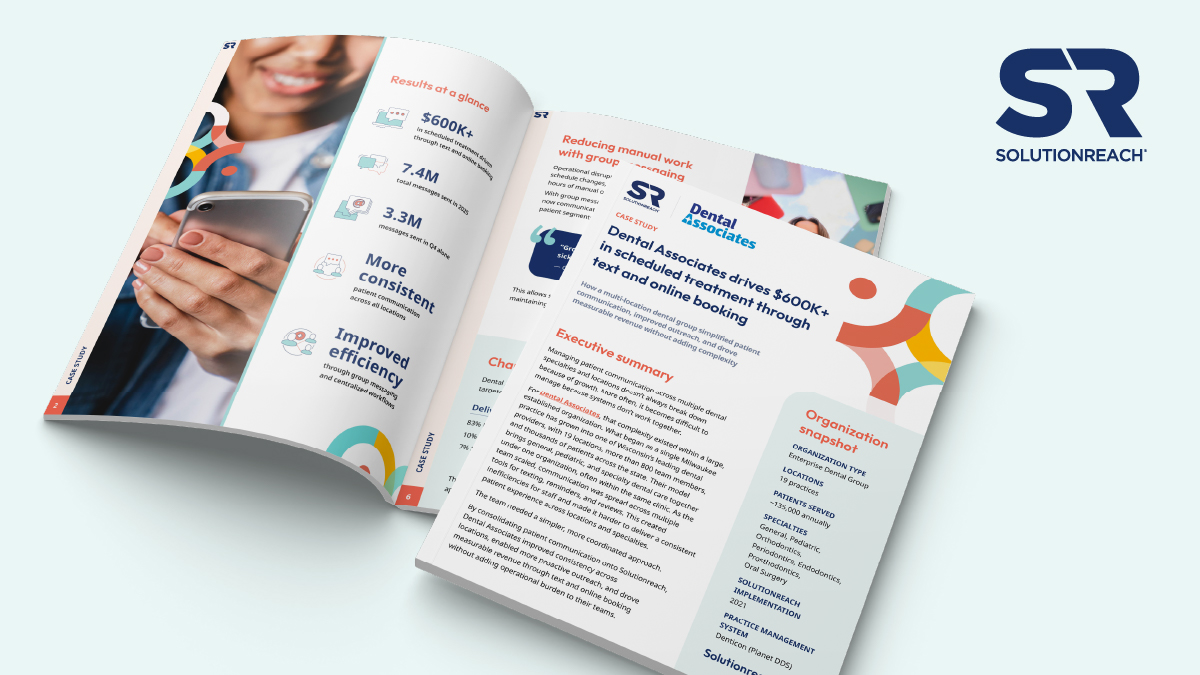
At a glance
| Metric | Result |
| Locations consolidated onto one platform | 19 |
| Messages sent in 2025 | 7.4 million (3.3 million in Q4) |
| Scheduled treatment attributed to text and online booking | $600,000+ |
Download Case Study: $600K+ in scheduled treatment through text and online booking
Why was a well-run dental group managing three different communication platforms?
This situation is more common than it looks from the outside. Organizations at scale typically acquire point solutions over time: one platform for texting, another for appointment reminders, a third for reputation management. Each tool was chosen for a good reason. Together, they created a system that no one designed — and that no one could manage consistently across 19 locations.
Dental Associates was using Podium for texting and reviews, Relatient for appointment confirmations, and Birdeye for reputation management. Each addressed a real need. But the aggregate effect was staff switching between platforms, location teams managing separate workflows, and patient communication that varied from clinic to clinic.
📊 First-party observation, Dental Associates case study “Patients love texting — they don’t want to call.” — Christina Pappalardo, Patient Experience Manager
As Christina Pappalardo, Dental Associates’ Patient Experience Manager, noted, patients’ expectations had shifted. They wanted text-based communication — not phone calls. The existing stack wasn’t positioned to deliver that experience consistently at scale.
What does patient communication fragmentation actually cost a multi-location dental group?
The costs show up in two places: operational inefficiency and scheduling gaps.
On the operational side, fragmented tools mean more manual work. When a provider calls in sick, someone has to reach the affected patients — historically, that meant hours of individual phone calls. At the scheduling level, fragmented outreach means less proactive recall, more gaps in the appointment book, and patients with unscheduled treatment who simply don’t get contacted.
The before-state at Dental Associates included all of these friction points: staff moving between platforms, limited ability to run coordinated campaigns across locations, and no centralized approach to managing patient conversations at scale.
How did Dental Associates consolidate patient communication across 19 locations?
The team consolidated onto Solutionreach’s enterprise platform to manage appointment reminders and confirmations, two-way texting, recall campaigns, patient newsletters, group messaging, and review invitations — all from a single platform integrated with their Denticon practice management system.
The structural change went beyond the platform. Instead of each clinic managing its own patient messages, Dental Associates moved to a centralized texting team. One coordinated team, one platform, and consistent workflows across all locations.
What each capability addressed:
Automated reminders reduced the manual work of confirmation follow-up and helped patients confirm or reschedule without calling in. Two-way texting gave patients a fast, convenient channel for questions and responses — reducing inbound phone volume. Patient newsletters created a consistent communication cadence between visits without requiring staff to write individual messages. Recall campaigns allowed the team to proactively reach patients with overdue or unscheduled treatment, rather than waiting for patients to initiate contact. Group messaging allowed the team to reach targeted patient segments instantly — particularly useful for schedule disruptions.
What did Dental Associates’ outreach look like at scale?
- Solutionreach platform data, Dental Associates (2025) 7.4 million total messages sent in 2025, with 3.3 million sent in Q4 alone.
- The 2025 delivery mix: 83% email, 10% SMTP, 7% SMS.
- The 2025 campaign mix: 65% newsletter, 15% recall, 12% appointment reminders — plus more than 37,000 targeted group messages sent.
This isn’t just scale for its own sake. The channel and campaign mix reflects a deliberate outreach strategy: newsletters to maintain ongoing patient relationships, recall campaigns to drive appointment scheduling, reminders to reduce no-shows, and group messaging to manage operational moments quickly.
How does group messaging change how a dental group responds to scheduling disruptions?
📊 First-party observation, Dental Associates case study “Group messaging is very efficient for when a provider calls in sick and staff doesn’t have to spend hours calling patients.” — Christina Pappalardo, Patient Experience Manager
The answer is immediate. When a provider is unexpectedly unavailable, the team can identify affected patients, compose a message, and reach all of them at once — in minutes rather than hours. Staff isn’t on the phone for the morning; the message is delivered and responses come back through the same channel.
For a group managing 19 locations with multiple providers per location, this kind of operational agility matters. The scenario isn’t unusual; the old response to it was.
$600,000+ in scheduled treatment — what does that number represent?
📊 Solutionreach platform data, Dental Associates Over $600,000 in scheduled treatment has been attributed to text and online booking, excluding phone calls.
This figure reflects treatment that was scheduled through text message or online booking — not calls. It’s a measure of what became possible once patients had faster, lower-friction ways to respond to outreach and schedule appointments. Recall campaigns and targeted group messaging drove the outreach; text and online booking made it easy for patients to act on it.
Before Solutionreach, Dental Associates was largely waiting for patients to call. The shift was from reactive to proactive: reach patients at the right time, through the channel they prefer, and make scheduling as easy as a text reply.
What does a more consistent patient communication model look like across 19 locations?
Coordinated messaging means patients at different Dental Associates locations receive consistent communication — the same confirmation cadence, the same recall approach, the same newsletter content. Standardized workflows mean staff across locations aren’t each maintaining their own communication system. Centralized campaign execution means outreach decisions are made once and deployed everywhere.
The practical effect: patients receive clearer, more convenient communication. Staff spend less time managing tools and more time managing patient relationships. And the organization has a clearer picture of what’s being sent, to whom, and when.
Why does this matter for other enterprise dental organizations?
Multi-location dental groups face a specific version of the communication problem: they’re large enough that inconsistency compounds but often structured in ways that make centralized communication management difficult. Point solutions accumulate. Location-level habits develop. And the overhead of coordinating across specialties and sites creates real operational drag.
Dental Associates’ experience illustrates what becomes possible when communication is treated as an organization-level capability rather than a location-level task: more consistent patient experience, more proactive outreach, measurable revenue tied to scheduling activity, and less manual work for the teams managing it all.
Frequently asked questions
What was the main operational challenge Dental Associates was trying to solve? The group was managing patient communication across three separate platforms — Podium for texting and reviews, Relatient for appointment confirmations, and Birdeye for reputation management. Each tool worked independently, but the combination created inconsistent workflows across 19 locations and limited the team’s ability to coordinate outreach at scale.
How much scheduled treatment has Dental Associates attributed to text and online booking? More than $600,000 in scheduled treatment has been attributed to text and online booking, excluding phone-initiated scheduling. This figure reflects treatment appointments that resulted from outreach delivered through text or completed through online booking.
What communication channels does Dental Associates use through Solutionreach? The platform supports appointment reminders and confirmations, two-way texting, recall campaigns, patient newsletters, group messaging for targeted outreach, and review invitations. The 2025 delivery mix was 83% email, 10% SMTP, and 7% SMS.
How does Solutionreach help a dental group manage provider scheduling disruptions? Group messaging allows the team to reach all affected patients simultaneously when a provider is unexpectedly unavailable — replacing individual phone calls with a single coordinated message. Christina Pappalardo, Dental Associates’ Patient Experience Manager, described the previous approach as requiring hours of manual outreach; group messaging makes this a near-immediate task.
How many patient messages did Dental Associates send through Solutionreach in 2025? More than 7.4 million total messages were sent in 2025, including 3.3 million in Q4 alone.
What changed operationally when Dental Associates moved to a single platform? The group also shifted from location-by-location communication management to a centralized texting team. One team managing one platform across all 19 locations produced more consistent patient communication and reduced the workload on front-office staff at individual clinics.
What types of outreach campaigns did Dental Associates run? The 2025 campaign mix included 65% patient newsletters, 15% recall campaigns, 12% appointment reminders, and more than 37,000 group messages. The recall and group messaging campaigns were particularly important for re-engaging patients with unscheduled treatment and filling open chair time.
Is Solutionreach designed for enterprise dental groups specifically? Solutionreach supports practices across the size spectrum — from single-location practices to enterprise groups with multiple locations and specialties. The Dental Associates story reflects the enterprise use case: centralized management, coordinated outreach across locations, and platform-level integration with their practice management system (Denticon by Planet DDS).
How does consolidating onto one patient communication platform affect staff workload? Consolidation reduces the number of tools staff need to access and the number of workflows they need to manage. At Dental Associates, this translated to a centralized team managing outreach across all 19 locations, rather than each location maintaining its own communication system. Staff time previously spent switching between platforms was redirected.
What practice management system does Dental Associates use, and does Solutionreach integrate with it? Dental Associates uses Denticon, developed by Planet DDS. Solutionreach integrates with Denticon as part of its practice management system integration library.
Ready to see how this works for your organization?
If your group is managing patient communication across multiple locations — whether you’re running two platforms or five — Solutionreach can show you how consolidation works in practice.
Request a demo → See how appointment reminders, recall campaigns, two-way texting, and group messaging work together in a single platform.
Download the Dental Associates case study → A PDF your team can reference, share, or bring into vendor evaluation conversations.


